The A1C test measures the percentage of your haemoglobin that has glucose attached to it, which reflects your average blood glucose over roughly the past two to three months. Below 5.7% is normal, 5.7–6.4% is prediabetes, and 6.5% or above on two occasions is diabetes. For most adults already diagnosed, the usual treatment target is below 7%. No fasting is needed.
What the A1C test measures
Haemoglobin is the protein in red blood cells that carries oxygen. Glucose in the blood attaches to it slowly and irreversibly, in proportion to how much glucose is around. The higher your average blood glucose, the larger the fraction of haemoglobin that ends up with glucose attached. That fraction is your A1C, also written HbA1c or "glycated haemoglobin".
Red blood cells live about 120 days, so at any moment your blood contains cells of every age. A1C therefore reflects a weighted average of glucose over roughly the past two to three months, with the most recent month counting for about half of the result.
This is what makes A1C useful. A single glucose reading tells you about one moment; A1C tells you about the whole quarter, including the nights and the hours after meals you never measured.
The ranges
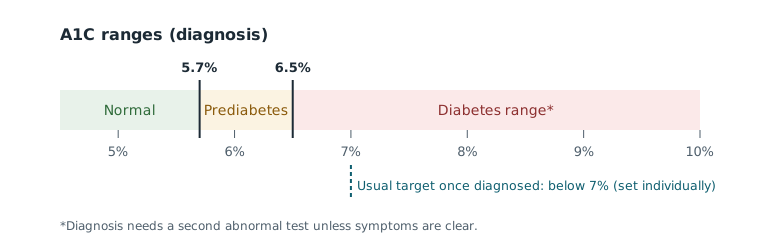
| A1C | Interpretation |
|---|---|
| Below 5.7% | Normal |
| 5.7% – 6.4% | Prediabetes |
| 6.5% or higher | Diabetes (confirmed by a second test unless symptoms are obvious) |
Once diabetes is diagnosed, A1C becomes a monitoring tool. The usual target for most non-pregnant adults is below 7%, and it is typically tested every three months while treatment is being adjusted and every six months once stable. Individual targets vary: tighter for some younger people, looser for older adults or those at risk of low blood sugar.
Outside the United States, A1C is often reported in mmol/mol instead of a percentage. 5.7% is 39 mmol/mol; 6.5% is 48 mmol/mol; 7% is 53 mmol/mol.
Converting A1C to average glucose
Laboratories often report an "estimated average glucose" (eAG) alongside A1C. It is calculated from a formula and expressed in the same units as a glucose meter, which helps connect the two.
| A1C | Estimated average glucose |
|---|---|
| 5% | 97 mg/dL (5.4 mmol/L) |
| 6% | 126 mg/dL (7.0 mmol/L) |
| 7% | 154 mg/dL (8.6 mmol/L) |
| 8% | 183 mg/dL (10.2 mmol/L) |
| 9% | 212 mg/dL (11.8 mmol/L) |
| 10% | 240 mg/dL (13.4 mmol/L) |
Each 1-point rise in A1C corresponds to roughly a 29 mg/dL (1.6 mmol/L) rise in average glucose. The formula is an average across many people, and an individual's true average can differ from it by a meaningful margin.
What the test involves
A1C is measured on a small blood sample, taken either from a vein or a finger-prick, at any time of day. No fasting or preparation is required. Results from a laboratory are usually available within a day or two; some clinics use point-of-care analysers that give a result in minutes.
When A1C can mislead
A1C assumes that red blood cells live a normal lifespan and that haemoglobin is normal. When either assumption fails, the number can be wrong in either direction.
A1C can read falsely low when red cells are turned over faster than usual, because they have less time to accumulate glucose:
- recent significant blood loss or blood transfusion
- haemolytic anemia
- treatment with iron, vitamin B12 or erythropoietin that boosts new red cell production
- late pregnancy
- some HIV medications
A1C can read falsely high when red cells live longer or when the assay is disturbed:
- iron-deficiency anemia (older cells, more glucose exposure)
- vitamin B12 or folate deficiency
- kidney failure
- very high triglycerides or bilirubin in some assays
Haemoglobin variants such as sickle cell trait, HbC or HbE can interfere with some laboratory methods. Modern assays handle most variants, but if you know you carry one, tell your doctor; a different test may be used.
There are also genuine differences between individuals in how readily glucose attaches to haemoglobin. Two people with identical average glucose can have A1C results a few tenths apart. Some evidence suggests A1C runs slightly higher in people of African ancestry at the same glucose level, which is one reason diagnosis relies on more than one test.
Where A1C is unreliable, doctors use fasting glucose, an oral glucose tolerance test, or — increasingly — data from continuous glucose monitors, which report "time in range" directly.
A1C and complications
The relationship between A1C and long-term complications is one of the best-established in medicine. The UK Prospective Diabetes Study and later trials showed that every 1-point reduction in A1C was associated with a substantial fall in eye, kidney and nerve complications. The benefit is not linear at the low end: pushing A1C below 6.5% with intensive medication in older people with long-standing diabetes has, in some trials, increased harm from low blood sugar without further reducing complications. That is the reasoning behind individualised targets.
What to do with your result
A single A1C in the prediabetes range is a reason to repeat it, check blood pressure and cholesterol, and start on the lifestyle changes described in the prediabetes guide. A result in the diabetes range is confirmed with a second test and followed by a conversation about treatment. If you already have diabetes and your A1C is above target, the discussion is about what to adjust — eating pattern, activity, medication, or all three — and re-testing in three months.
Frequently asked questions
Do I need to fast for an A1C test?
No. A1C reflects months of glucose exposure, so what you ate this morning does not change it. It can be taken at any time of day.
How quickly can A1C change?
Because red blood cells live about 120 days, A1C responds gradually. A real change in average glucose shows up partly within a month and fully within about three. That is why it is usually re-tested every three months when treatment is being adjusted.
Is a home A1C kit accurate?
Some over-the-counter kits are reasonably accurate, but variation between kits and laboratories can be several tenths of a percent. A diagnosis should always rest on a laboratory test.
What is a "good" A1C if I have diabetes?
Below 7% is the general target for most adults, because it is the level below which complication risk falls substantially without excessive risk of low blood sugar. Older adults, people with other serious illnesses, or those prone to hypoglycemia are often given a target of 7.5–8%. Your own target should come from your care team.
My A1C is normal but my fasting glucose is high. Which is right?
Both can be right. They measure different things — one an average over months, the other a single morning value. Discordant results are common; your doctor may repeat one of them or add a glucose tolerance test.
References
- NIDDK. The A1C Test & Diabetes (2023). https://www.niddk.nih.gov/health-information/diagnostic-tests/a1c-test
- MedlinePlus, U.S. National Library of Medicine. Hemoglobin A1C (HbA1c) Test (2023). https://medlineplus.gov/lab-tests/hemoglobin-a1c-hba1c-test/
- NIDDK. Diabetes Tests & Diagnosis (2023). https://www.niddk.nih.gov/health-information/diabetes/overview/tests-diagnosis
- American Diabetes Association, Diabetes Care 49(Suppl 1):S27–S49. 2. Diagnosis and Classification of Diabetes: Standards of Care in Diabetes—2026 (2026). PubMed PMID 41358893. https://diabetesjournals.org/care/article/49/Supplement_1/S27/163926/2-Diagnosis-and-Classification-of-Diabetes
This page contains no product recommendations or affiliate links. It is general health information, not personal medical advice. Read our editorial policy and medical review policy.