FortBite is a brushing tooth powder — bentonite and kaolin clays, calcium carbonate, and a named herb-and-oil set (cinnamon, clove, peppermint, ginger, myrrh, lemon peel, stevia) — about $49 for a 45 g jar with a consistent 60-day guarantee, and the only product in our oral queue that names every ingredient. As a topical abrasive-plus-flavor formula it's coherent chemistry. The review turns on its usage instruction: FortBite is sold to replace toothpaste, which means quitting fluoride — the most heavily proven decay-prevention molecule that exists — for unquantified clays with no abrasivity data and no trials. Evidence rating: 2.0/5. Product Fit Score: 3.2/5. Its "rebuilds enamel" and acid-reflux claims add the category's usual fiction to an otherwise unusually visible product.
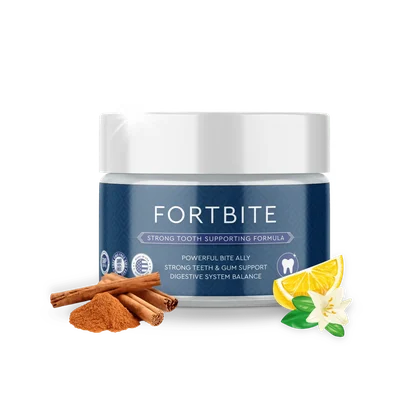
FortBite
- Form
- powder
- Price
- $49 (1 bottle)
- Guarantee
- 60-day money-back (stated by seller)
- Sold via
- maxweb
- Label amounts
- Label web-sourced and unusually consistent — all 11 ingredients named across listings incl. an Amazon panel (45 g jar); no amounts or abrasivity (RDA) data; marketed to REPLACE toothpaste, i.e. to drop fluoride
✓ 60-day refund window stated by seller — long enough to run an honest self-trial
Check current price on the seller's site
Affiliate link. Prices and guarantee as shown on the seller's page on 3 September 2026; they may have changed. Not independently verified beyond that page.
Evidence & product fit
| Product Fit factor | Score (out of 5) | Why |
|---|---|---|
| Formula completeness | 2.5 | Best in our oral set — all 11 ingredients named consistently, Amazon listing with a panel, named format and quantity (45 g). Docked for absent amounts and RDA, and for enamel-"rebuild" plus acid-reflux claims a brushing powder can't support. |
| Ease of use | 4.0 | The powder format is generally straightforward, but clear serving directions were not available in the product facts we verified. |
| Guarantee & buying terms | 3.5 | 60 days, consistently stated, empty-jar returns described. |
| Price / value | 2.0 | ~$49 for 45 g versus ~$3 for fluoride toothpaste doing the evidenced job. |
| Category relevance | 4.0 | The named formula is broadly aligned with oral health positioning. Category relevance measures fit to the intended use; it does not mean the finished product has been clinically proven effective. |
Might suit you if…
- Someone wanting an occasional natural polishing powder alongside — not instead of — fluoride toothpaste, who accepts unknown abrasivity on their enamel
- {'The disclosure-minded buyer': 'if you insist on this category, this is what a fully named label looks like'}
Skip it if…
- Anyone planning to follow the label and drop fluoride toothpaste — that trades dentistry's best evidence for its absence, and cavity risk doesn't negotiate
- Anyone with existing enamel wear, sensitivity or gum recession — unquantified clay abrasion is the wrong experiment
- Anyone buying for the acid-reflux angle — reflux is a real condition with a real page, and a brushing powder doesn't treat it
The Evidence Rating reflects research on the finished product and/or named ingredients for the intended use. The Product Fit Score is a separate practical assessment of formula completeness, ease of use, guarantee/buying terms, price/value and category relevance. Neither score is a customer rating, and affiliate relationships do not determine either score. See the full scoring method.
What FortBite is
FortBite is a topical brushing powder — dip a wet brush, brush two minutes, twice daily — built on bentonite and kaolin clays with calcium carbonate and a fully named herb-and-oil roster, ~$49 per 45 g jar, 60-day guarantee, and, uniquely in our oral set, a label you can actually read: eleven ingredients, all named, consistent across its funnel pages and an Amazon panel. After six reviews of anonymous blends, that's worth stating plainly: this is what disclosure looks like, and its transparency score reflects it.
The problem is the job it applies for
As an addition — an occasional polishing powder — FortBite is coherent: calcium carbonate is a standard abrasive, clove and cinnamon oils have genuine lab-dish antimicrobial activity, and the flavor chemistry is real. But FortBite isn't sold as an addition; its instructions replace toothpaste "exclusively." That single word carries the review: it removes fluoride — the one molecule whose decay prevention is dentistry's best-proven fact — and substitutes clays with no published abrasivity (RDA) data, no amounts, and no trials, while promising enamel "rebuilding" and even acid-reflux benefits (see FAQ, and the real reflux page).
| The honest ledger | |
|---|---|
| Full ingredient disclosure | Best in category — genuine credit |
| Topical format | Right delivery for cleaning claims |
| Fluoride | Absent — and the label tells you to quit yours |
| Abrasivity data | None published for a twice-daily abrasive |
| Enamel-rebuild / reflux claims | Unsupported |
Verdict
2.5/5 — the score of a well-labeled product with a harmful instruction. Kept alongside fluoride toothpaste as an occasional cosmetic, it's a defensible indulgence; used as directed, it trades the strongest evidence in oral health for scented clay. The gum-disease and decay pages hold the boring winning routine — fluoride, floss, dentist — that no jar improves by subtraction.
Frequently asked questions
Is brushing with clay bad for teeth?
It depends on abrasivity, which FortBite doesn't publish. Toothpastes carry RDA values (dentists flag concern above ~150; enamel-safe products cluster far lower); clays range widely depending on particle size and processing. Twice-daily brushing with an unmeasured abrasive is an experiment your enamel runs without data — the specific reason "natural" doesn't settle safety here.
What's wrong with replacing toothpaste?
One word: fluoride. Its cavity-reduction evidence — decades of trials, all ages, endorsed by every dental body — is the strongest in oral health, and it works topically at every brushing. FortBite's exclusive-use instruction removes it entirely. Used occasionally alongside fluoride toothpaste, the powder is a cosmetic choice; used as directed instead of it, it's a decay-risk decision the marketing never prices.
Can it help acid reflux or "rebuild" enamel?
No mechanism connects brushing your teeth with a powder to stomach-acid regulation — the reflux framing borrows a real erosion cause (covered on the acid-reflux page) to sell an unrelated product. And enamel doesn't rebuild beyond the surface remineralization that saliva, fluoride and (in early lesions) hydroxyapatite chemistry provide; no clay does this.
What's dangerous about an abrasive instruction on an honest label?
FortBite's roster is unusually well-disclosed, but its usage instructions center on brushing with a clay-based powder — and abrasivity is toothpaste's most safety-tested property, measured on the RDA scale precisely because enamel doesn't regrow. An unrated abrasive used daily can do permanent mechanical damage that no mineral in the same jar offsets, and 'natural clay' is not a gentleness certificate (many clays are aggressive polishers). This inverts the usual review problem: instead of fake ingredients with big claims, real ingredients with a physically risky protocol. If any powder product tempts you, the one number that matters is a published RDA under ~150 — absent that, the $3 regulated tube wins on safety alone.
FortBite — from $49 · 60-day seller refund window
Check current price on the seller's site Compare oral health supplements
Affiliate links. Our evaluation is unaffected — the criterion scores above explain the verdict either way.
References
- National Institute of Dental and Craniofacial Research. Periodontal (Gum) Disease (2024). https://www.nidcr.nih.gov/health-info/gum-disease
- U.S. Food and Drug Administration. Dietary Supplements (2024). https://www.fda.gov/food/dietary-supplements
- Federal Trade Commission. FTC Endorsement Guides (2023). https://www.ftc.gov/business-guidance/resources/ftcs-endorsement-guides-what-people-are-asking
Supplements do not replace brushing with fluoride toothpaste, flossing, dental cleanings or treatment for tooth decay and gum disease. Persistent bleeding, swelling, severe tooth pain, facial swelling or a mouth sore that does not heal needs dental or medical assessment.