FemiCore is a once-daily women's urinary capsule ($69/$59/$49 by bundle, consistent 60-day ClickBank guarantee) with genuinely above-average disclosure — a 400 mg capsule holding a 350 mg herbal blend (mimosa pudica, cranberry at 30% PACs, bearberry, berberine HCl 8%) plus five named Lactobacillus strains including L. crispatus — and a marketing promise its ingredients don't own: fewer leaks, less urgency, drier laughs. Stress incontinence is a pelvic-floor mechanics problem with a real first-line fix (pelvic floor training) no capsule replicates; the formula's actual evidence base — cranberry PACs for recurrent-UTI prevention, L. crispatus for vaginal flora — belongs to different outcomes it barely advertises. Evidence rating: 2.5/5. Product Fit Score: 3.4/5.
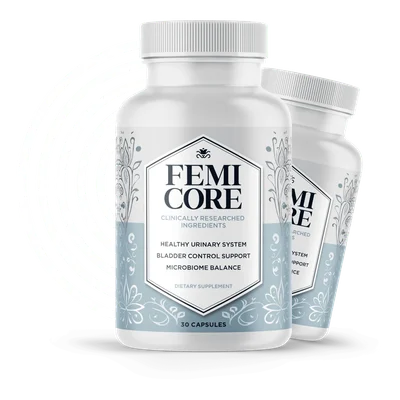
Femicore
- Form
- capsule
- Price
- $69 (1 bottle) · $59/bottle (3) · $49/bottle (6)
- Guarantee
- 60-day money-back (stated by seller)
- Sold via
- maxweb
- Label amounts
- Label web-sourced incl. a detailed label walkthrough: 400 mg total per capsule — 350 mg herbal blend with stated standardizations (cranberry 30% PACs, berberine HCl 8%) + five named Lactobacillus strains with codes; per-ingredient amounts not broken out; one page adds D-Mannose others don't; one review describes a different (menopause, 2-capsule) product under this name; fake $179 anchor on one page; 60-day ClickBank guarantee consistent
✓ 60-day refund window stated by seller — long enough to run an honest self-trial
Check current price on the seller's site
Affiliate link. Prices and guarantee as shown on the seller's page on 3 September 2026; they may have changed. Not independently verified beyond that page.
Evidence & product fit
| Product Fit factor | Score (out of 5) | Why |
|---|---|---|
| Formula completeness | 2.5 | Upper tier for this market — nine named ingredients, strain codes, blend totals (350 mg herbal + probiotics in a 400 mg capsule), two stated standardizations — docked for missing per-ingredient amounts, a D-Mannose roster conflict between pages, a $179 fake anchor, and a circulating review that describes an entirely different product under this name. |
| Ease of use | 4.5 | The capsule format is generally straightforward, but clear serving directions were not available in the product facts we verified. |
| Guarantee & buying terms | 3.5 | 60 days via ClickBank, consistently stated with empty-bottle mechanics. |
| Price / value | 2.0 | $49–69/bottle; the blend total makes meaningful cranberry-PAC content possible but unprovable. |
| Category relevance | 4.2 | The named formula is broadly aligned with women's health positioning. Category relevance measures fit to the intended use; it does not mean the finished product has been clinically proven effective. |
Might suit you if…
- The recurrent-UTI-prone woman whose clinician has suggested cranberry prophylaxis and who'd rather have the probiotic-botanical combination than plain PAC capsules — knowing the per-ingredient doses are unproven
Skip it if…
- Anyone buying for leaks, urgency or nighttime trips — stress and urge incontinence have real, effective first-line care (pelvic-floor training, bladder retraining, medication review) that this formula's marketing quietly substitutes itself for
- Anyone planning months of continuous use — bearberry (uva ursi) is a short-course herb; its hydroquinone chemistry is why herbal references cap its duration, a limit no FemiCore page mentions
- Anyone on diabetes medication — berberine is glucose-active, undosed here
The Evidence Rating reflects research on the finished product and/or named ingredients for the intended use. The Product Fit Score is a separate practical assessment of formula completeness, ease of use, guarantee/buying terms, price/value and category relevance. Neither score is a customer rating, and affiliate relationships do not determine either score. See the full scoring method.
What FemiCore is
FemiCore is a once-daily women's urinary capsule sold via ClickBank at $69/$59/$49 per bottle with a consistent 60-day guarantee, and a label that — by this market's standards — approaches respectable: 400 mg per capsule, a 350 mg herbal blend (mimosa pudica seed, cranberry standardized to 30% PACs, bearberry leaf, berberine HCl 8%) plus five named Lactobacillus strains including L. crispatus, with strain codes. Missing: per-ingredient amounts, an explanation for why one page adds D-Mannose, and any mention of bearberry's short-course tradition.
Right science, wrong storefront
Graded against its actual ingredient files, FemiCore is a recurrent-UTI-prevention and vaginal-flora formula (see our probiotics evidence page for the strain-specificity rule): cranberry PACs carry real Cochrane-reviewed prevention evidence, and L. crispatus is the species healthy urogenital ecology is built on. But its sales pages sell continence — fewer leaks, drier laughs, fewer night trips — outcomes that belong to pelvic-floor mechanics and have their own strong first-line care no capsule provides. That substitution is the harm our women's-health category page grades hardest: the buyer with stress incontinence spends $294 and six months not doing the pelvic-floor training that actually works. (Nocturia has its own cause list, too.)
| The ledger | |
|---|---|
| Label disclosure | Top quartile — names, codes, totals, standardizations |
| Per-ingredient doses | Not broken out — the PAC math stays unprovable |
| Marketing claim vs ingredient evidence | Continence promised; UTI-prevention is what the science covers |
| Bearberry duration caution | Absent from every page |
| 60-day guarantee | Consistent, ClickBank |
Verdict
2.6/5 — one of the better-built labels in our queue, docked for selling itself against the wrong condition and omitting its own herb's usage limits. The evidence-first sequence for its two real audiences: leaks → pelvic-floor training (first-line, trial-backed, free); recurrent UTIs → a prevention conversation with your clinician, where dosed cranberry-PAC products — and possibly this one, if its math is honest — have their modest, legitimate place.
Frequently asked questions
What does the cranberry evidence actually support?
Prevention of recurrent UTIs — modestly, in the right people. The 2023 Cochrane review found cranberry products reduce recurrence risk in women with repeat infections, with ~36 mg of proanthocyanidins (PACs) daily as the commonly cited threshold. FemiCore's 30%-PAC standardization is the right spec, and its 350 mg blend could mathematically carry enough — but per-ingredient amounts aren't broken out, so the one number that matters stays unverifiable. Note what the evidence is not: treatment of active infections (antibiotic territory) or bladder control.
Why can't probiotics help with leaks?
Because leaks are plumbing, not flora. Stress incontinence comes from pelvic-floor muscle and sphincter mechanics (laughing, coughing, lifting), urge incontinence from bladder-muscle signaling — and the first-line treatments are pelvic-floor muscle training and bladder retraining, with strong trial support. L. crispatus dominance is genuinely good for vaginal and urinary-tract ecology (fewer pathogenic colonizations), which is UTI-prevention logic, not continence logic. The marketing collapses that distinction; the evidence doesn't.
What's the bearberry caution?
Bearberry (uva ursi) works via arbutin, which the body converts to hydroquinone — effective enough as a short-course traditional urinary antiseptic that herbal references limit use to about a week at a time, a few courses a year, and advise against it in pregnancy and kidney disease. A daily-forever capsule containing an unstated amount of a short-course herb is a formulation choice the sales pages never address.
Femicore — from $69 · 60-day seller refund window
Check current price on the seller's site Compare women's health supplements
Affiliate links. Our evaluation is unaffected — the criterion scores above explain the verdict either way.
References
- NIDDK. Bladder Infection (Urinary Tract Infection) in Adults (2017). https://www.niddk.nih.gov/health-information/urologic-diseases/bladder-infection-uti-in-adults
- NCCIH. Cranberry: Usefulness and Safety (2020). https://www.nccih.nih.gov/health/cranberry
- U.S. Food and Drug Administration. Dietary Supplements (2024). https://www.fda.gov/food/dietary-supplements
Symptoms attributed to “hormone imbalance” can have many causes and should not be self-diagnosed from a supplement sales page. Supplements do not replace evaluation for abnormal bleeding, pregnancy-related concerns, severe pelvic pain or persistent menopausal symptoms. Herbal products may interact with medicines and may be inappropriate during pregnancy or breastfeeding.