VertiAid is a chewable balance-support capsule sold via BuyGoods ($69×2 / $59×3 / $49×6 bottles, 60-day guarantee) whose attributed formula shifts by page — vitamin D3, collagen, ginseng, anti-inflammatory enzymes, B6, "marine minerals," sometimes ginkgo — with no doses anywhere and claimed peer-reviewed trials that don't exist. The one real kernel: randomized research has shown vitamin D (with calcium) reduces recurrence of BPPV, the most common vertigo cause, in deficient patients. That finding belongs to tested-and-dosed vitamin D, not to this label. Evidence rating: 1.5/5. Product Fit Score: 2.9/5. Diagnosis first is the entire game here.
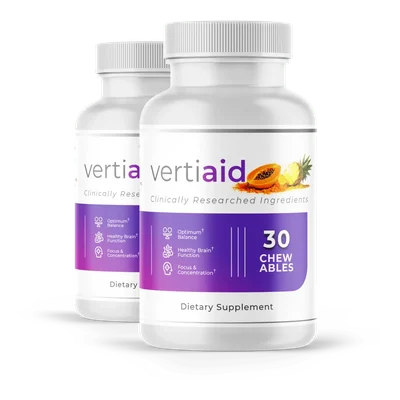
VertiAid
- Form
- chewable tablet
- Price
- $69/bottle (2) · $59/bottle (3) · $49/bottle (6)
- Guarantee
- 60-day money-back (stated by seller)
- Sold via
- buygoods_or_direct
- Label amounts
- Label web-sourced; ingredient attributions vary by page with no doses; guarantee 60 days dominant (one page claims 90); pages assert peer-reviewed trials of 'targeted combinations' reducing vertigo recurrence — no such product trials exist; a 5/5-from-4.5K rating circulates unhosted; collagen allergy note (shellfish/egg) appears on one page
✓ 60-day refund window stated by seller — long enough to run an honest self-trial
Check current price on the seller's site
Affiliate link. Prices and guarantee as shown on the seller's page on 3 September 2026; they may have changed. Not independently verified beyond that page.
Evidence & product fit
| Product Fit factor | Score (out of 5) | Why |
|---|---|---|
| Formula completeness | 1.5 | Ingredient attributions shift between pages (D3/collagen/ginseng/enzymes/B6/marine minerals, sometimes ginkgo), no amounts anywhere, guarantee mostly 60 days with a 90 outlier, and self-generated 5/5 statistics. |
| Ease of use | 4.5 | The chewable tablet format is generally straightforward, but clear serving directions were not available in the product facts we verified. |
| Guarantee & buying terms | 3.5 | 60 days via BuyGoods, dominant and mechanics-described. |
| Price / value | 1.5 | $49–69/bottle for undosed contents when the researched version (vitamin D after a deficiency test) costs a few dollars. |
| Category relevance | 3.5 | Parts of the named formula are aligned with hearing and tinnitus support positioning. Category relevance measures fit to the intended use; it does not mean the finished product has been clinically proven effective. |
Might suit you if…
- Almost no one as sold — even the vitamin-D idea is better executed as a $10 bottle after a 25-OH-D blood test, at a dose your clinician picks
Skip it if…
- Anyone with undiagnosed vertigo — BPPV, vestibular neuritis, Ménière's, migraine and medication effects are distinguished by examination, and the most common one is cured by a maneuver, not a molecule
- Anyone whose dizziness comes with double vision, slurred speech, weakness, or severe imbalance — same-day emergency care, no supplements in the sentence
- Shellfish/egg-allergic buyers — one VertiAid page flags its collagen source for exactly this
The Evidence Rating reflects research on the finished product and/or named ingredients for the intended use. The Product Fit Score is a separate practical assessment of formula completeness, ease of use, guarantee/buying terms, price/value and category relevance. Neither score is a customer rating, and affiliate relationships do not determine either score. See the full scoring method.
What VertiAid is
VertiAid is a chewable sold against dizziness and "inner ear balance" through BuyGoods funnels — $69×2, $59×3, $49×6, 60-day guarantee — with an ingredient story that changes by page (D3, collagen, ginseng, enzymes, B6, marine minerals, sometimes ginkgo), no doses anywhere, invented "peer-reviewed trials" of the formula, and a self-scored 5/5 from 4,500 unfindable reviewers. Familiar machinery. What's different is the symptom it aims at — and what that symptom actually needs.
Vertigo is a diagnosis problem wearing a supplement costume
Dizziness has a short, famous cause list — BPPV (crystals; the majority), vestibular neuritis, Ménière's, vestibular migraine, medications, and the rare-but-urgent neurological causes — each with a different fix, sorted by examination in minutes. The category's quiet harm is routing that examination into a checkout: BPPV's fix is a free repositioning maneuver; neuritis wants early steroids-and-rehab conversations; the emergency signs (FAQ) want an ambulance. The one supplement fact with real trial support — vitamin D for recurrent BPPV in the deficient — is exactly the kind of finding this product borrows and blurs: it belongs to tested deficiency and stated doses, neither of which VertiAid offers.
Verdict
2.0/5 — a real kernel, unreachable through this label. The sequence that outperforms the whole aisle: diagnosis (often one exam), the maneuver if it's BPPV, a 25-OH-D test if episodes recur, and dosed vitamin D if you're actually low. Total cost: less than one bottle; evidence: more than the entire hearing category combined.
Frequently asked questions
Is there really vitamin D research on vertigo?
Yes — the honest kernel in this category. In randomized research, correcting vitamin D (with calcium) in deficient BPPV patients meaningfully reduced recurrence of episodes. Note every load-bearing word: deficient (tested), BPPV specifically (diagnosed), known doses (stated). VertiAid states no dose, tests nothing, and aims at all "dizziness" — the research it borrows doesn't stretch that far.
What actually fixes most vertigo?
The most common cause — BPPV, loose crystals in the inner ear's canals — is treated by canalith-repositioning maneuvers (Epley and relatives): a few minutes of guided head positions, high success rates, free to repeat, performable at home once taught. That a maneuver outperforms every product in this aisle is the single most useful fact a vertigo sufferer can buy, and it costs nothing.
When is dizziness an emergency?
New vertigo with any of: double vision, trouble speaking or swallowing, facial droop, limb weakness or numbness, severe headache, or inability to walk — these are stroke-territory signs needing same-day emergency care. Sudden hearing loss with vertigo is also urgent. No capsule, including this one, belongs anywhere near that decision.
When is dizziness a supplement question versus a medical one?
Almost always medical — vertigo has specific, treatable causes a bottle can't touch — BPPV (loose inner-ear crystals, fixed in minutes by a repositioning maneuver like the Epley, the single most satisfying cure in medicine), vestibular neuritis (time and rehab exercises), Ménière's (salt management, specific medications), medication side effects, and blood-pressure drops on standing. Each has a distinct fix and none of them is botanical. Red flags — vertigo with double vision, slurred speech, weakness, or severe headache — are stroke territory and emergency care. A supplement's only honest role here is the ginger tablet for motion-sickness nausea; everything else on this aisle's labels is borrowing urgency it can't treat.
VertiAid · 60-day seller refund window
Check current price on the seller's site Compare hearing and tinnitus supplements
Affiliate links. Our evaluation is unaffected — the criterion scores above explain the verdict either way.
References
- NIDCD. Hearing Loss and Older Adults (2023). https://www.nidcd.nih.gov/health/hearing-loss-older-adults
- U.S. Food and Drug Administration. Dietary Supplements (2024). https://www.fda.gov/food/dietary-supplements
- Federal Trade Commission. FTC Endorsement Guides (2023). https://www.ftc.gov/business-guidance/resources/ftcs-endorsement-guides-what-people-are-asking
Supplements have not been shown to restore lost hearing or cure tinnitus. Sudden hearing loss, one-sided hearing change, severe dizziness or neurologic symptoms need prompt medical evaluation; sudden sensorineural hearing loss can be time-sensitive. Review supplement ingredients for medication interactions before use.