Synaptigen is a once-daily gut-brain "psychobiotic" ($69 single / $49×6, excellent 180-day empty-bottle guarantee via ClickBank) containing Lactobacillus paracasei, L. reuteri and Bifidobacterium lactis BL-04 with inulin — and no CFU counts anywhere, the probiotic equivalent of a label with no milligrams. The field it borrows from is real but young: certain specific strains have small trials on stress and mood measures; none of that transfers to uncounted strains, and nothing in the literature supports the memory-decline positioning or the "reduces sugar buildup in neurons" mechanism, which no paper has ever described. Its format drifts between capsule and melt-tablet by page. Evidence rating: 1.5/5. Product Fit Score: 3.1/5. Our probiotics page holds the honest state of the gut-brain field.
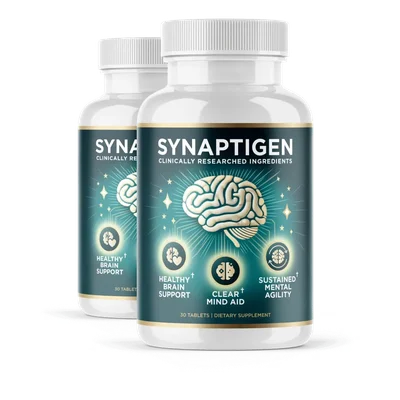
Synaptigen
- Form
- capsule
- Price
- $69 (1 bottle) · $49/bottle (6)
- Guarantee
- 180-day money-back (stated by seller)
- Sold via
- maxweb
- Label amounts
- A 'psychobiotic' gut-brain formula: three probiotic strains with NO CFU counts anywhere, plus inulin and flavor/filler; format drifts (capsule vs melt-in-mouth tablet by page); reviews contradict each other on whether the blend is proprietary; 'reducing sugar buildup in neurons' is an invented mechanism; 180-day empty-bottle guarantee very consistent; ClickBank
✓ 180-day refund window stated by seller — long enough to run an honest self-trial
Check current price on the seller's site
Affiliate link. Prices and guarantee as shown on the seller's page on 3 September 2026; they may have changed. Not independently verified beyond that page.
Evidence & product fit
| Product Fit factor | Score (out of 5) | Why |
|---|---|---|
| Formula completeness | 1.5 | No CFU counts for any strain — the probiotic equivalent of no milligrams — plus a capsule-versus-melt-tablet format drift across pages, third-party reviews contradicting each other on whether the blend is proprietary, and an invented mechanism doing the explaining. |
| Ease of use | 4.5 | The capsule format is generally straightforward, but clear serving directions were not available in the product facts we verified. |
| Guarantee & buying terms | 4.5 | 180 days, empty bottles accepted, stated consistently across the ecosystem — genuinely excellent terms. |
| Price / value | 1.5 | $49–69 for uncounted bacteria and inulin. |
| Category relevance | 3.5 | Parts of the named formula are aligned with brain and memory support positioning. Category relevance measures fit to the intended use; it does not mean the finished product has been clinically proven effective. |
Might suit you if…
- The gut-brain-curious buyer who reads our probiotics page first, accepts "small mood-tier effects for some counted strains" as the field's ceiling, and mostly values the six-month refund window
Skip it if…
- Anyone buying for memory or age-related decline — no psychobiotic trial anywhere supports that endpoint; the reversible-cause checkup remains the aisle's answer
- Anyone immunocompromised — live multi-strain products with unknown CFU need clinician clearance
- Anyone persuaded by the neurons-and-sugar mechanism — it appears in no scientific literature; a product that invents its physiology grades all its other sentences
The Evidence Rating reflects research on the finished product and/or named ingredients for the intended use. The Product Fit Score is a separate practical assessment of formula completeness, ease of use, guarantee/buying terms, price/value and category relevance. Neither score is a customer rating, and affiliate relationships do not determine either score. See the full scoring method.
What Synaptigen is
Synaptigen is a once-daily gut-brain product at $69/$49×6 with an excellent, consistent 180-day empty-bottle guarantee — containing L. paracasei, L. reuteri, B. lactis BL-04 and inulin, with no CFU counts anywhere, a format that drifts between capsule and melt-tablet by page, reviews that contradict each other on whether the blend is proprietary, and a mechanism — "reducing sugar buildup in neurons" — that exists in no scientific literature.
The field is real; the count is blank
The brain aisle's gut-brain entry gets the queue's standard two-ledger treatment: the field (psychobiotics) is genuinely interesting, young, and mood-tier at best; the product is uncountable — strains without CFU are herbs without milligrams — and its flagship claims (memory, decline, neuronal sugar) belong to no study in that field or any other. The LeanBiome and PrimeBiome reviews graded this ladder's upper rungs; Synaptigen stands below both, redeemed by the aisle's best refund terms. For the memory-worried buyer it targets, the checkup is still the only product on this page with an answer inside.
| The ledger | |
|---|---|
| Psychobiotic field | Real, early, mood-tier |
| CFU counts | None — the whole label question |
| Memory/decline trials for these strains | None exist |
| "Sugar buildup in neurons" | Invented |
| Guarantee | 180 days, empty bottles — excellent |
Verdict
2.2/5 — a good word, a blank label, a great refund desk. The honest gut-brain experiment is a counted strain from our probiotics page; the honest memory move hasn't changed all aisle.
Frequently asked questions
What does the psychobiotic field actually show?
Early, real, modest — randomized trials of specific strains (certain L. helveticus/B. longum combinations, L. rhamnosus in animal work that famously didn't replicate in humans, a few L. paracasei and B. lactis studies) show small improvements on stress, anxiety and mood questionnaires in some populations, with mechanisms (vagal signaling, short-chain fatty acids, inflammation) under genuine study. What the field has not shown: memory improvement, cognitive-decline prevention, or anything at all for uncounted strains — the exact promises this label leads with.
Why do CFU counts matter as much as milligrams?
Because dose is dose — probiotic trials specify billions of colony-forming units of a named strain, and effects don't survive translation to "contains some." A label listing bacteria without counts is exactly as informative as one listing herbs without milligrams: it tells you a category, not an amount. Our PrimeBiome review credited a stated-but-low 0.5B; Synaptigen states nothing, which is the rung below.
What's the "sugar buildup in neurons" claim about?
Nothing in science — no literature describes cognitive decline as sugar accumulating in neurons that probiotics clear. It's a plausible-sounding image assembled from real words (glucose metabolism matters; diabetes affects the brain) into a mechanism no researcher has proposed. We've catalogued this move across the queue — real vocabulary, fictional physiology — and it reliably marks copy written to sound like science rather than report it.
What would a psychobiotic product with real evidence look like today?
Narrow and modest — which is the tell for spotting the honest version. It would name one or two strains with human RCTs (specific L. paracasei, B. longum or L. helveticus combinations have small stress/mood trials), print CFU in the studied billions, claim exactly the studied endpoints ('may modestly reduce perceived stress over 4–8 weeks'), and cost $20–35. Several such products exist in the mainstream market. What the field cannot yet honestly sell: memory improvement, decline prevention, or any 'sugar in neurons' mechanism. The gap between that modest real product and this label's promises is a fair measure of the whole funnel category — the science is a seedling; the marketing sells the forest.
Synaptigen — from $69 · 180-day seller refund window
Check current price on the seller's site Compare cognitive support supplements
Affiliate links. Our evaluation is unaffected — the criterion scores above explain the verdict either way.
References
- National Institute on Aging. Memory Problems, Forgetfulness, and Aging (2023). https://www.nia.nih.gov/health/memory-loss-and-forgetfulness/memory-problems-forgetfulness-and-aging
- NCCIH. Probiotics: What You Need To Know (2019). https://www.nccih.nih.gov/health/probiotics-what-you-need-to-know
- Federal Trade Commission. FTC Endorsement Guides (2023). https://www.ftc.gov/business-guidance/resources/ftcs-endorsement-guides-what-people-are-asking
Memory or focus supplements do not treat dementia, Alzheimer’s disease or another cause of cognitive decline. New, worsening or function-limiting memory problems deserve medical assessment. Check formulas for stimulant, sedative, anticholinergic or blood-thinning interactions, especially if you take prescription medicines.